Petrol – Peaks – Progress
Forbidden technology – from the beginnings until 1925
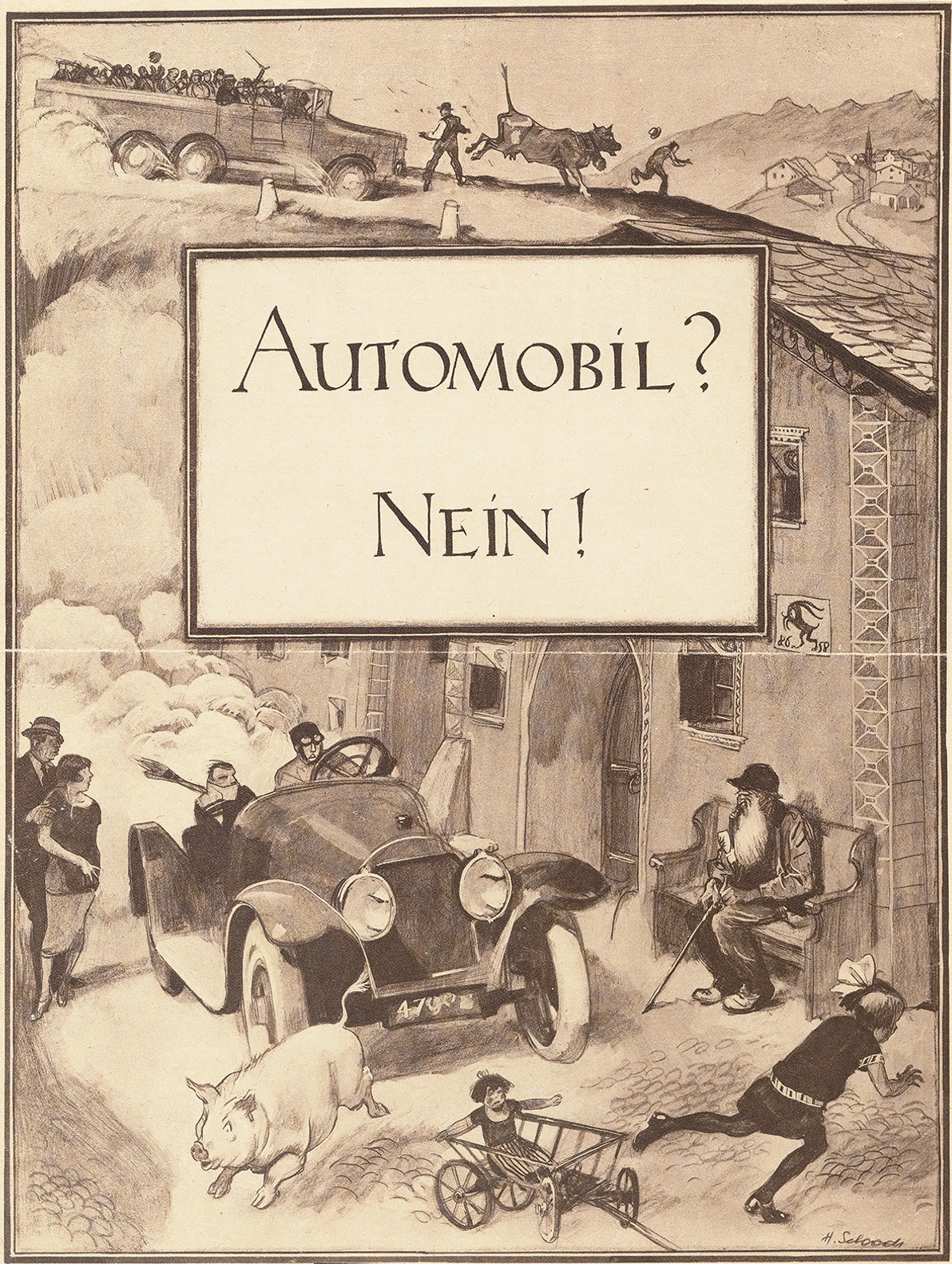
At the turn of the century, the automobile was a technical curiosity in many places – in Graubünden, the Grisons, however, it was considered a real threat. In 1900, the canton responded with a rigorous ban: motor vehicles were not allowed on public roads.
The reasons for the rejection were manifold: fear of noise, stench and dust, but above all safety on the narrow mountain roads. A flyer from this time sums up the attitude: "Automobiles? No!" (photo below).
Back then, roads were living spaces: horse-drawn carriages, bicycles, children, animals and pedestrians shared the paths. A suddenly appearing car - at that time not much faster than 20 kilometers per hour - upset a fragile balance. Horses shied and the pedestrians complained about clouds of dust. The resistance was widespread: the people of the Grisons confirmed the decades-long driving ban eight times in cantonal referendums - a national exception.
But change was about to set in. With the growth of tourism and the interests of hotel owners, transport companies and the first motorists, there were more and more voices in favor of lifting the ban. However, the First World War postponed that discussion for the time being. But when the military trucks arrived in the valleys and most of the horses being drafted for the war at the same time, the long-standing transport order began to crumble. The total number of horses in the canton declined, which plunged the Grisons into a transport crisis and made the movement of goods massively more expensive.
In this tense situation, more and more exemptions for cars were granted - for example for medical supplies during the Spanish Flu. The Federal Government also pushed for an easing of the restrictions, which further fueled the political debate. The car opponents knew how to cleverly exploit the mistrust of the “foreign, dictatorial influences from Berne” again and again to keep resistance alive.
It was not until the ninth cantonal referendum in 1925 that the tide turned: by a narrow margin - the yes vote was 52 percent - the population lifted the ban, thus being the last canton in Switzerland to do so. One photo impressively documents the transitional period: if you wanted to get to St. Moritz by car, you had to improvise. For example, it was permitted to have motor vehicles pulled by horses - an interim solution that seems bizarre today.
Years of change – 1925 to about 1945
As soon as the driving ban was lifted, rapid change set in - as can be seen from the figures: in 1925, 136 cars were registered in the canton of the Grisons, which corresponded to not even one car per thousand inhabitants. By 1930, the number rose to already 1,051 car/1000 inhabitants. The car was not only tolerated, but increasingly celebrated. St. Moritz recognized the potential at a very early stage: the first International Automobile Week took place as early as 1929 - a major event with a rally, a hill climb competition, a beauty contest in front of the Kurhaus and the Hotel Victoria in St. Moritz Bad as well as different social events.
The heart of the event was the legendary Bernina Mountain Race, the course of which consisted of more than 16 kilometers of winding roads. For the so-called kilometer race, the mineral oil company Shell had the road between Punt Muragl and Samedan asphalted - an important act of infrastructure for the region (photo below) with a lasting sponsorship effect: Even today, this stretch is still known among locals as the “Shellstrasse”.
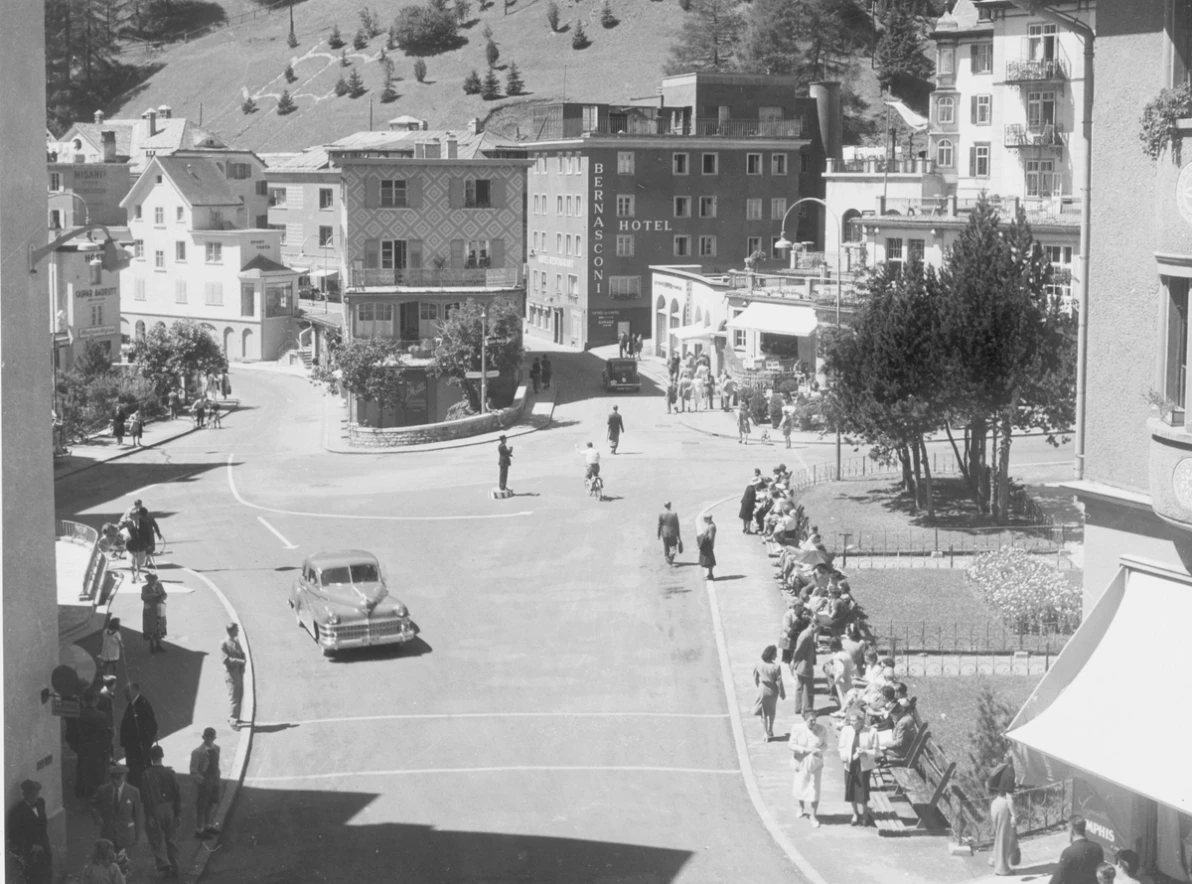
Several photos document the social change: the car became the symbol of a modern, urban lifestyle - especially in fashionable St. Moritz. The roads were increasingly asphalted, such as Via Traunter Plazzas, and the automobile conquered the public space. The change from the common traffic area to a car-centered infrastructure was clearly noticeable.
Events such as the International Alpine Rides attracted the public. At the same time, the first car garages were built, such as the Central Garage. In order to cope with the new traffic conditions, St. Moritz employed traffic wardens who not only regulated the traffic but were also contact persons for motorists. The future also made its way into developing the motor vehicles further: the Saurer 2A postal coach with skis attached under the front wheels or the Citroën Kégresse tracked vehicle with half-track drive (photo below ) impressively demonstrate the transition from slow traffic to a new automotive mobility.
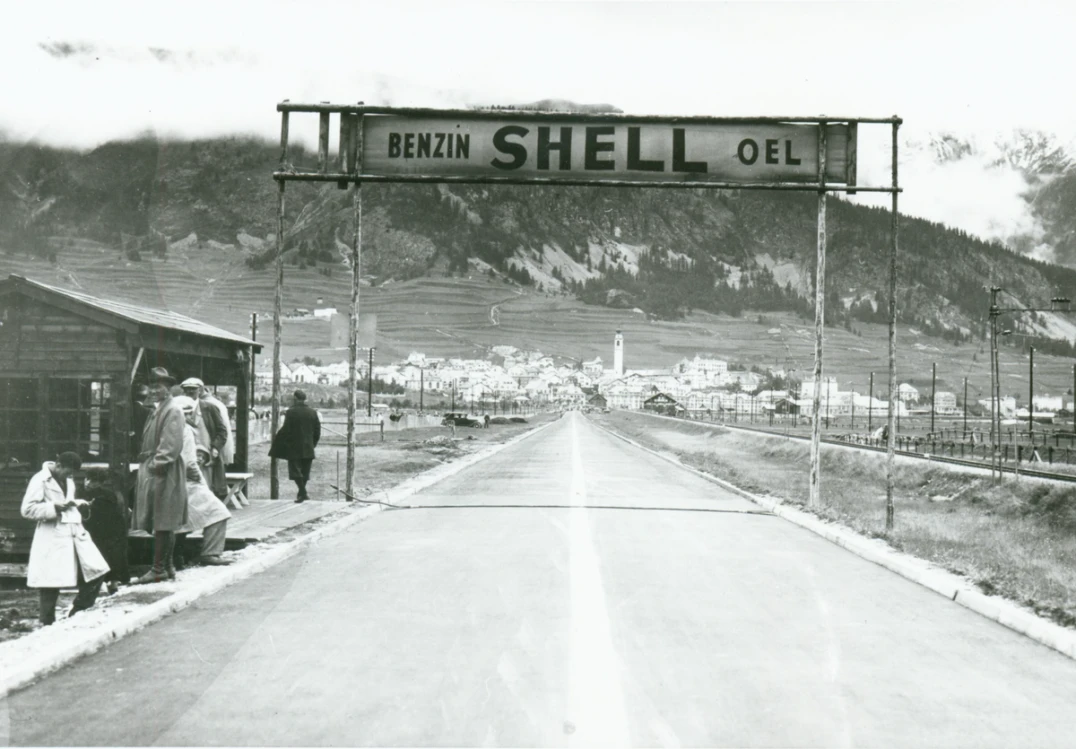
1st International St. Moritz Automobile Week, Kilometer race on the Shellstrasse, in the background Samedan, 1929 © Photo collection of the St. Moritz Documentation Library
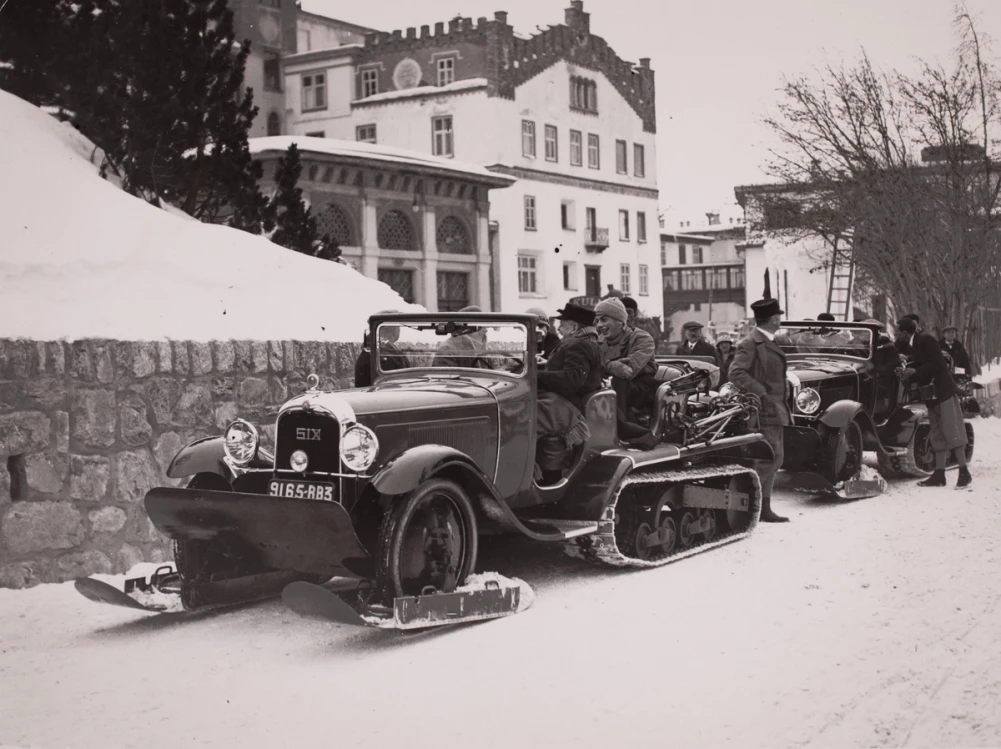
Citroën Kégresse tracked vehicle with half-track drive in front of the Kulm Hotel, ca. 1928 © Photo collection Documentation Library St. Moritz
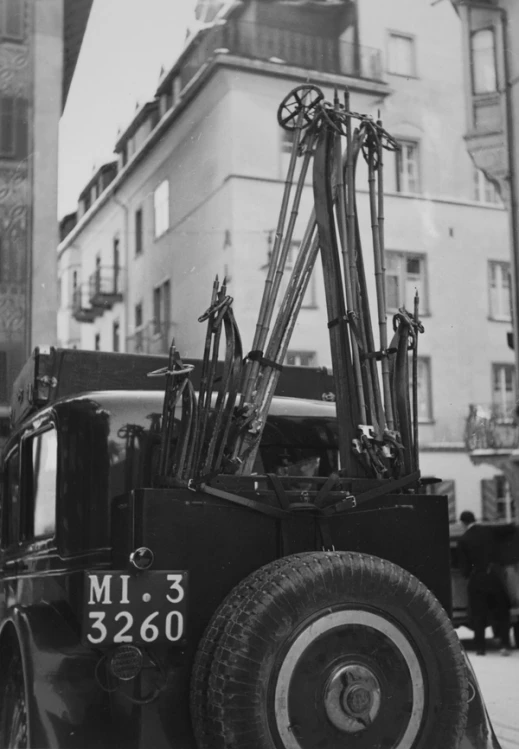
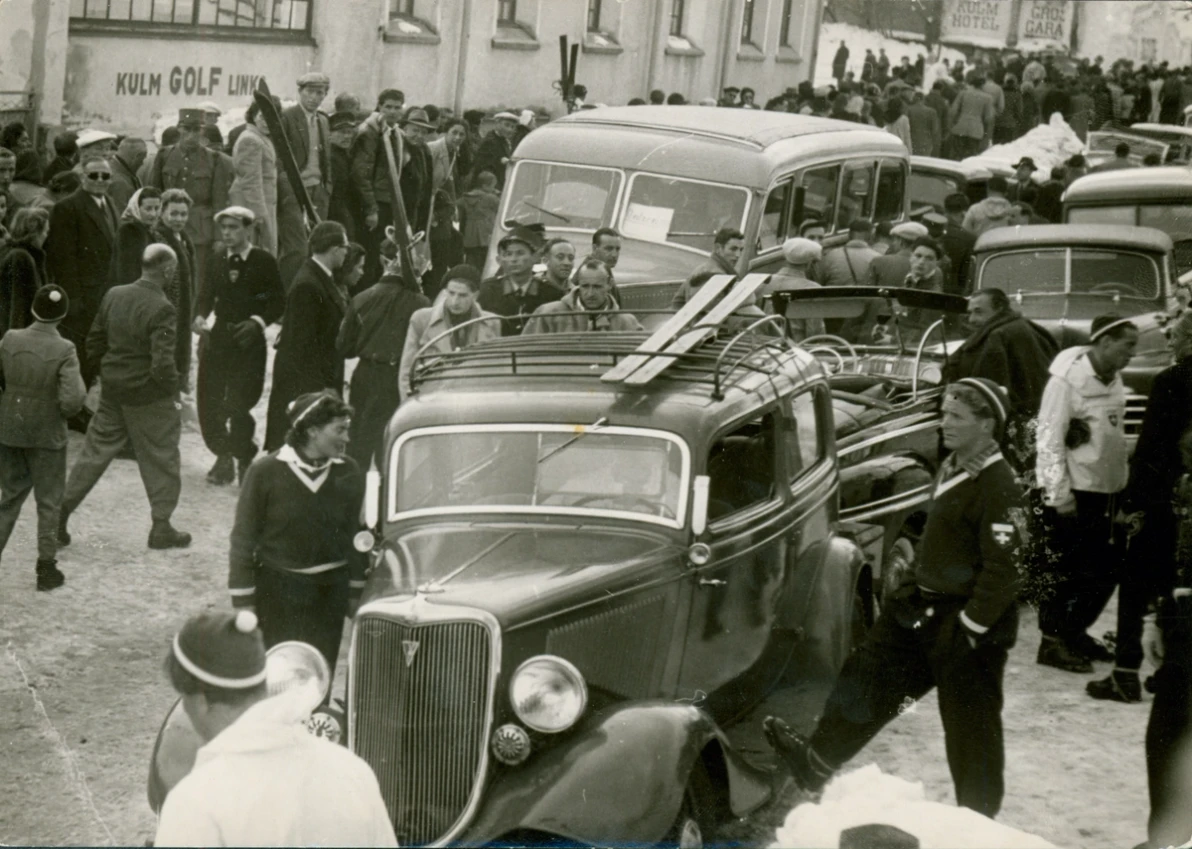
Ski transport, ca. 1930 © H. Niedecken
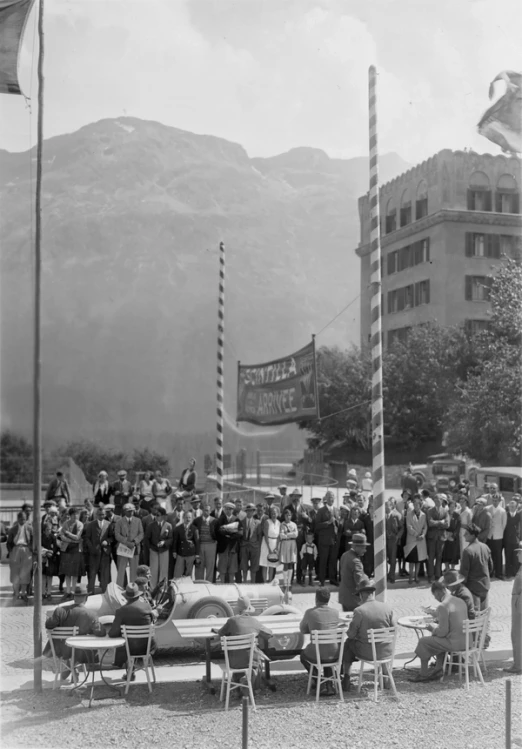
3rd International Alpine Tour, arrival at the Kulm Hotel, 1931 © H. Niedecken
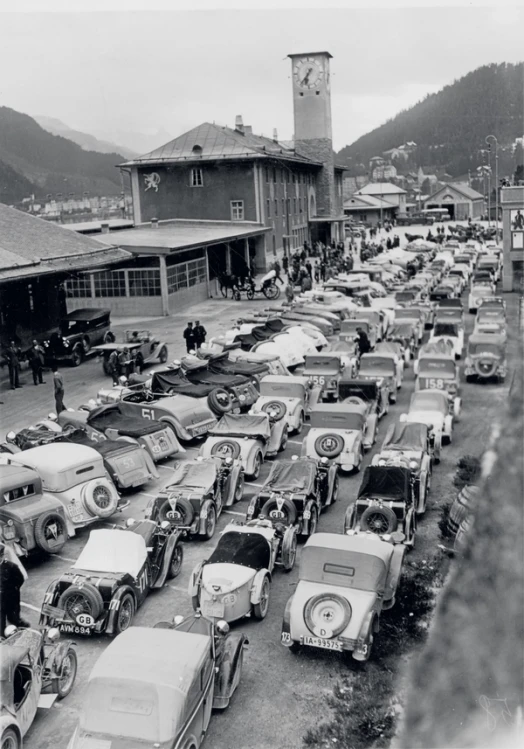
6th International Alpine Tour, gathering at the train station, 1934 © H. Niedecken
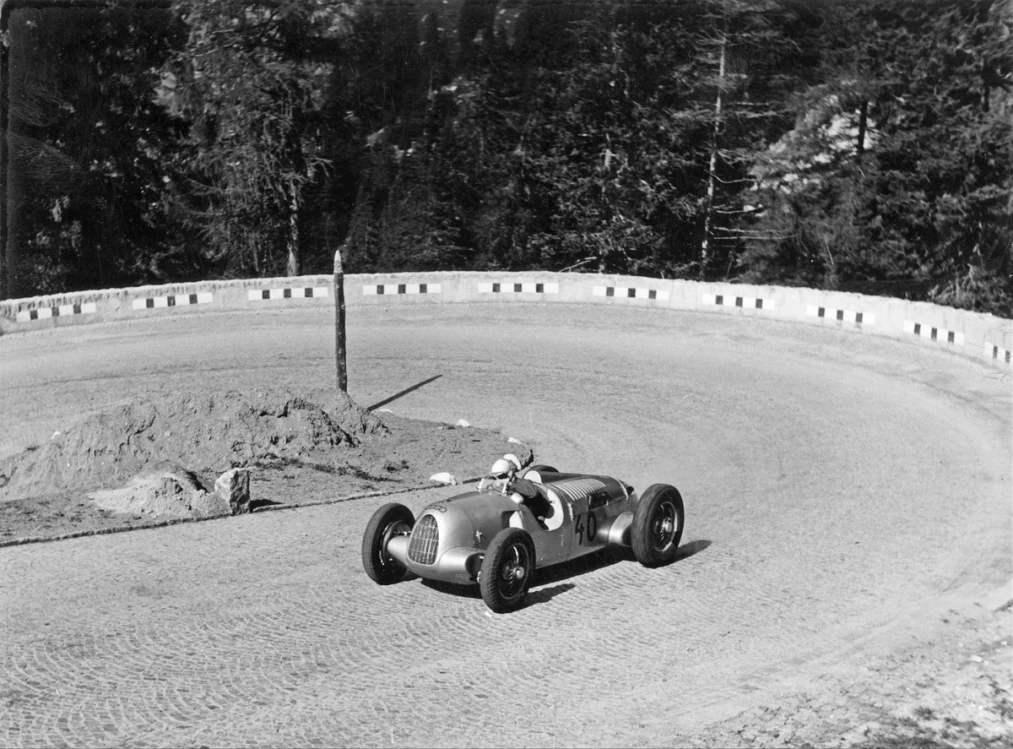
I. National Maloja Hill Climb, 25.9.1938 © H. Niedecken
1st International St. Moritz Automobile Week, Kilometer race on the Shellstrasse, in the background Samedan, 1929 © Photo collection of the St. Moritz Documentation Library
Citroën Kégresse tracked vehicle with half-track drive in front of the Kulm Hotel, ca. 1928 © Photo collection Documentation Library St. Moritz
Ski transport, ca. 1930 © H. Niedecken
3rd International Alpine Tour, arrival at the Kulm Hotel, 1931 © H. Niedecken
6th International Alpine Tour, gathering at the train station, 1934 © H. Niedecken
I. National Maloja Hill Climb, 25.9.1938 © H. Niedecken
1st International St. Moritz Automobile Week, Kilometer race on the Shellstrasse, in the background Samedan, 1929 © Photo collection of the St. Moritz Documentation Library
Citroën Kégresse tracked vehicle with half-track drive in front of the Kulm Hotel, ca. 1928 © Photo collection Documentation Library St. Moritz
Ski transport, ca. 1930 © H. Niedecken
3rd International Alpine Tour, arrival at the Kulm Hotel, 1931 © H. Niedecken
6th International Alpine Tour, gathering at the train station, 1934 © H. Niedecken
I. National Maloja Hill Climb, 25.9.1938 © H. Niedecken
Mobility in everyday life - from around 1945
In the following decades, motor vehicles became an integral part of everyday life for everyone who had already owned a car. The “PTT Bus” (postal coach) shaped the new street scene and motorized private transport also increased considerably. Whether it was trips to shops, family outings or a quick trip to a neighboring village, the car was no longer the exception but the rule.
The new mobility changed the townscape, the background noise and the relationship between the town and its surrounding landscape. St. Moritz would not be St. Moritz if the automobile had not also been put at the service of pleasure and sport: The picture of the Maloja Mountain Race is a reminder of the passion for racing in those years - still held on cobblestone roads at the time.
An architectural highlight of that period is the Conrad petrol station in St. Moritz. Its clear lines and covered roof are reminiscent of American design and exemplify the modern attitude to life that the car had brought along.
The return of doubt - the car today
The automobile has been the subject of controversy for some time now. Climate change, the increasing scarcity of space and traffic noise are putting it under pressure. In Switzerland, there are more and more car-free zones, cities are having second thoughts and e-mobility is no longer seen as a remedy to all of our problems. The numbers of new cars being sold are no longer rising as strongly as they used to do. At the same time, new forms of mobility are gaining in importance. The understanding of luxury has also undergone a change: a car is no longer automatically seen as a status symbol - understatement and sustainability characterize the thinking of the new generations. This has brought us full circle: after a century of expansion, the automobile is now in need of better explanations than ever.
And yet: St. Moritz remains a place where the automobile is celebrated. With events such as the British Classic Car Meeting St. Moritz, the “Passione Engadina”, the “Hill Climb” Bernina Gran Turismo or The ICE St. Moritz (International Concours of Elegance) on the frozen Lake St. Moritz, the passion for the automobile lives on. St. Moritz is also a magnet for car enthusiasts from all over the world besides the events mentioned above. The affinity for cars is evident in everyday life as well as in small details: Badrutt's Palace Hotel, for example, still picks up its guests from Engadin Airport in its legendary Rolls-Royce. And the original, four-wheel-drive Fiat Panda which Gianni Agnelli once drove through St. Moritz, has become a celebrated cult vehicle for a creative elite, not least thanks to St. Moritz. In many places, especially in St. Moritz, the car is still much more than just a means of transport. It embodies an attitude of life and is part of an analogue world of experience which still exerts great fascination today.
For information about free guided tours click here.
More than flowers: “Plus quam flores” by Gian Giovanoli at the St. Moritz Design Gallery•A house of many lives: Villa Beaulieu, formerly home to Klinik Gut•“I Contain Multitudes”: Light art in public spaces by Marinella Senatore•Paris has a new fragrance. And St. Moritz takes centre stage: PARIS–ST. MORITZ by CHANEL.•